
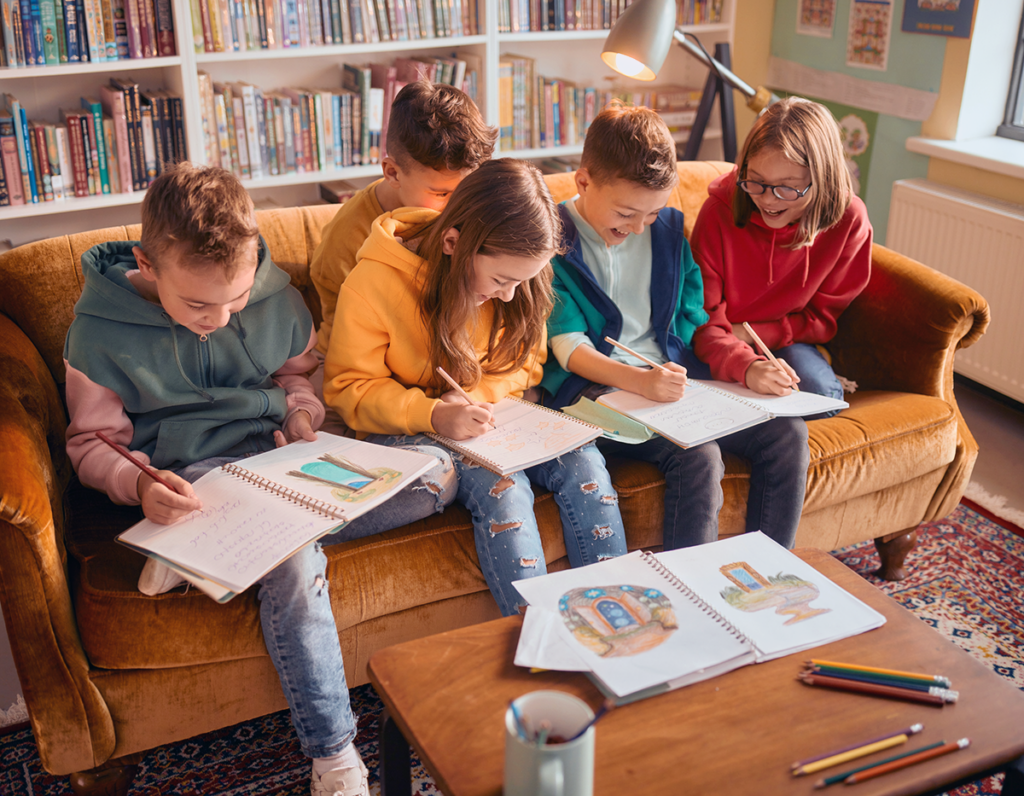
What if an old couch was a portal to adventure?
That single question powers the entire Under the Couch series — and it can spark meaningful learning in the classroom, too.
The Under the Couch stories begin with something every child knows — an ordinary couch — and lead Spencer and Justin into worlds filled with imagination, challenges, choices, and discovery. Along the way, they encounter important life lessons about courage, friendship, responsibility, empathy, and making good choices.
For educators, that combination creates a natural springboard for creative writing, literacy, social-emotional learning, classroom discussion, and community building — while keeping students engaged because, first and foremost, they’re having fun with a story.
The couch is the doorway to adventure.
What happens on the other side is where the learning begins.
Portal Stories as a Writing Engine
After a class read-aloud from the series, give students a simple challenge: An ordinary object in your home is secretly a doorway. Where does it lead?
Then let their imaginations take over.
- Where does the portal lead?
- What does this new world look and feel like?
- Who — or what — lives there?
- What are the rules?
- What danger or challenge awaits?
- And most importantly: What does the character learn before coming home?
The structure is already there: ordinary world, threshold, strange world, challenge, return. That gives even hesitant writers a roadmap.
Adventure stories naturally introduce the building blocks of narrative writing — setting, character, conflict, rising action, and resolution — without making students feel as though they’re filling out a plot diagram.
They’re learning story structure because they’re building a story they want to tell.
For teachers looking for a more scaffolded approach, ReadWriteThink’s story structure lesson plans can pair well with a portal-story unit, helping students understand beginning, middle, and end before they create worlds of their own.
Writing Prompts to Try
- The back of your closet is actually a doorway. Where does it lead?
- You open the refrigerator and discover another world inside.
- Your favorite stuffed animal knows how to open a portal — but only at midnight.
- The school library has a book that is actually a doorway. What happens when you step through?
- You discover that your old couch has been taking you somewhere while you sleep.
The goal isn’t simply to write a fantastical story. It’s to give students a reason to want to write.
Portal Stories as an SEL Springboard
The adventures of Spencer and Justin aren’t just about what happens when they go under the couch. They’re also about how they respond to what happens to them.
Their adventures put them in situations that children can recognize, even when the worlds themselves are anything but familiar: the excitement of discovering something new, anxiety about starting a new school, frustration with a sibling, suspicion of the mysterious Ms. Lori, and the very real fear of facing danger without knowing whether they’ll make it home safely.
Along the way, the boys have to make choices. They have to manage their emotions, listen to each other, solve problems, take responsibility for their actions, and figure out what to do when things don’t go according to plan.
That’s where the SEL opportunity lives.
The books aren’t trying to deliver an SEL lesson. Instead, the characters are navigating the same kinds of emotions, relationships, choices, and challenges that children encounter in their own lives.
That’s one of the strengths of using fiction for social and emotional learning. Students can talk about a character’s feelings, choices, and challenges before they have to talk about their own. The story provides a comfortable distance — and sometimes that distance makes an honest conversation easier.
CASEL, the Collaborative for Academic, Social, and Emotional Learning, describes SEL as the process through which young people develop skills related to identity, emotions, relationships, and responsible decision-making. Fiction can provide a natural way to explore those ideas through characters and situations students already care about.
Try Asking:
- “Spencer was angry that his family moved and he had to leave his friends behind. When has a change in your life felt unfair at first?”
- “Justin made a choice that seemed like a good idea at the time. Have you ever made a choice that turned out differently than you expected?”
- “If you could give Spencer one piece of advice before he entered this world, what would it be?”
The conversation doesn’t have to end with the book. A discussion about Spencer and Justin can open the door to conversations about belonging, courage, empathy, friendship, decision-making, change, responsibility, and managing difficult emotions.
And sometimes, a child who isn’t ready to talk about their feelings is very willing to talk about Spencer’s.
That’s the power of story.
The post on classroom lessons from the series offers additional book-based discussion starters.
Portal Stories as a Literacy-Culture Builder
The couch doesn’t have to stay between the covers of a book. Schools can bring the idea to life.
Imagine a reading corner built around an old couch. A decorated “portal door” at the library entrance. A hallway display where every classroom creates the world behind its own door. A schoolwide writing challenge where students design portals, write stories, and share them with one another.
For administrators looking for a low-cost way to create energy around reading and writing, a schoolwide “Portal Story Month” could be a fun place to start, with the Under the Couch book series as a shared read-aloud anchor.
You could even turn the school into the portal.
Ask every classroom: If our classroom had a portal, where would it take us? Why?
One class might travel to a world where everyone speaks in rhyme. Another might discover a planet where books come alive. Another might enter a world where students have to solve a mystery before they can return home.
Students write the stories. Create the artwork. Build the displays. Read their work aloud.
Now literacy isn’t just something happening in the classroom. It’s something happening all around them. And that’s how a book can become more than something students read. It can become something they experience together.
The Wonder Is the Point
At its heart, the Under the Couch series is built on a simple idea: Wonder can be hiding inside ordinary things.
A couch can be a portal.
A hallway can become another world.
A writing assignment can become an adventure.
And a conversation about a character can become a conversation about ourselves.
That’s the opportunity for educators.
The most memorable learning experiences don’t always begin with a worksheet or a standard written on the board.
Sometimes they begin with a question that makes a child lean forward and wonder: “What if?”
And on the other side of that question might be a story, a conversation, a new idea — or an entirely new way of seeing the world.
Get Started
Ready to bring Under the Couch into your classroom?
Explore the Teachers page for educator resources, revisit our classroom lessons from the series, and join the Under the Couch community for new books and classroom ideas.